
How to organize hair tools in bathroom drawer comes down to two things: keeping heat and cords under control, and giving every tool a “home” you can stick to on busy mornings.
If your drawer turns into a hot, tangled mess, it’s not because you’re “bad at organizing”, it’s usually because the drawer isn’t set up for long items, bulky attachments, and that one cord that refuses to behave. The good news is you don’t need a full bathroom remodel to fix it.
Below is a practical setup that works in most U.S. bathrooms, even when drawers are shallow or shared. You’ll get a quick self-check, a layout that makes sense, and a few safety-minded habits that prevent melted liners and scorched brushes.
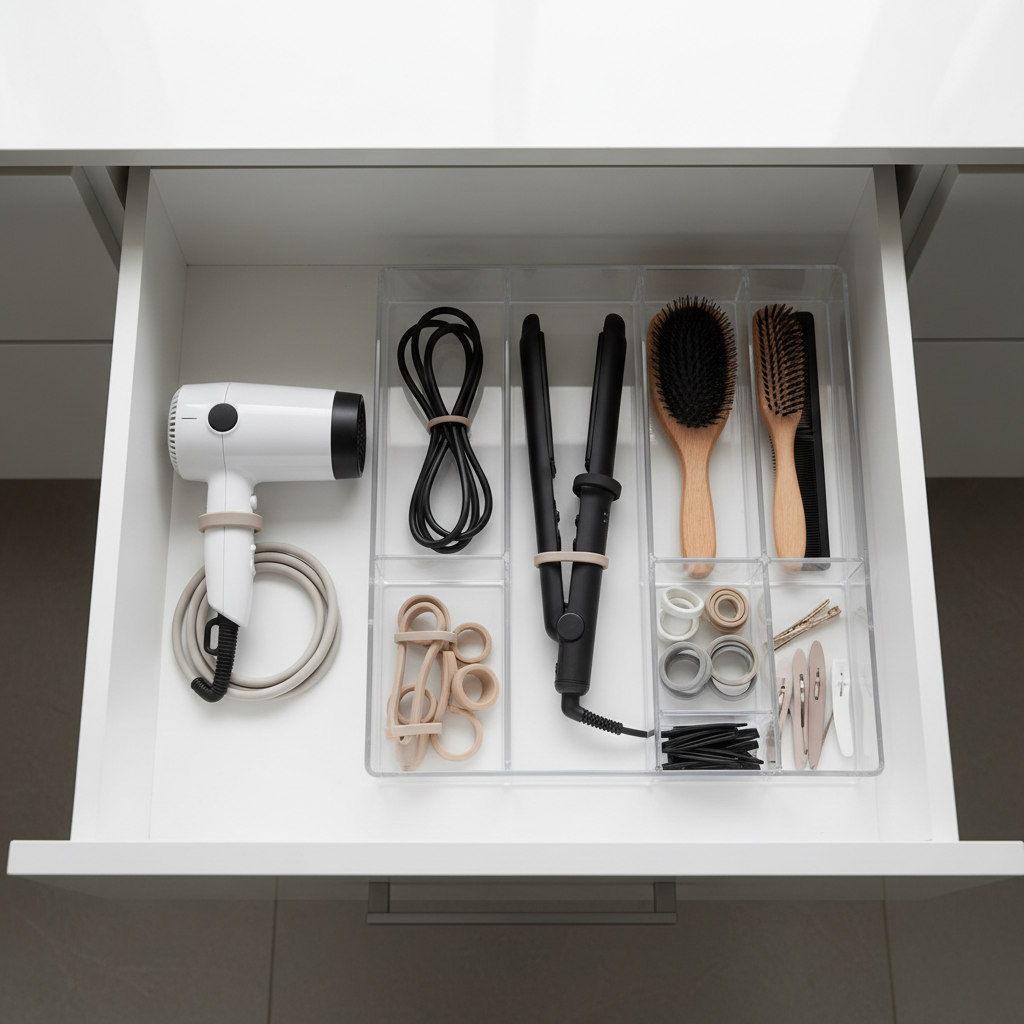
Start with a realistic goal (and a quick reset that actually lasts)
Before you buy bins, decide what “organized” means for your routine. For most people, it’s not a Pinterest-perfect drawer, it’s opening the drawer and grabbing the right tool in one motion, without unspooling a knot of cords.
A fast reset that tends to hold up:
- Empty the drawer completely, wipe it down, and remove any old liner that smells like heat or hairspray.
- Make three piles: daily tools (hair dryer, hot tool, brush), weekly tools (diffuser, extra barrels), rarely used (travel dryer, backup iron).
- Toss obvious duplicates you never reach for, or move them to a “backup” bin outside the bathroom.
Many drawers fail because they try to store everything. Your drawer should store what you actually use, where you actually use it.
Why bathroom drawers get chaotic: the usual culprits
If you feel like you organize and it “reverts” in a week, you’re probably fighting one of these:
- Heat timing: hot tools get put away too soon, so you avoid organizers and just drop them in.
- Cord sprawl: long cords and bulky plugs take over the space, then snag every time you open the drawer.
- Wrong dividers: short, shallow trays don’t support long tools, so everything drifts.
- Attachment creep: concentrators, diffusers, wands, clips, and elastics slowly invade the same drawer.
- Shared drawers: skincare, makeup, and hair tools compete, and hair tools usually “win” by volume.
According to the U.S. Consumer Product Safety Commission (CPSC), products that generate heat can pose burn or fire risks if misused. In a bathroom, that typically means storage habits matter more than people think, especially around towels, paper products, and cramped spaces.
Self-check: which drawer setup do you need?
Pick the description that matches your situation, it’ll guide your layout.
- Small drawer, big tools: shallow depth, limited height, tools barely fit.
- Medium drawer, shared storage: enough space, but mixed categories cause clutter.
- Deep drawer (or vanity cabinet drawer): plenty of depth, but items get lost.
- High-heat routine: daily flat iron/curling iron use, must plan for cooling time.
If you’re in the “small drawer, big tools” camp, your win condition is fewer items plus better cord control. If you’re in “deep drawer,” the win is “zones” plus containers that prevent items from sinking into a pile.
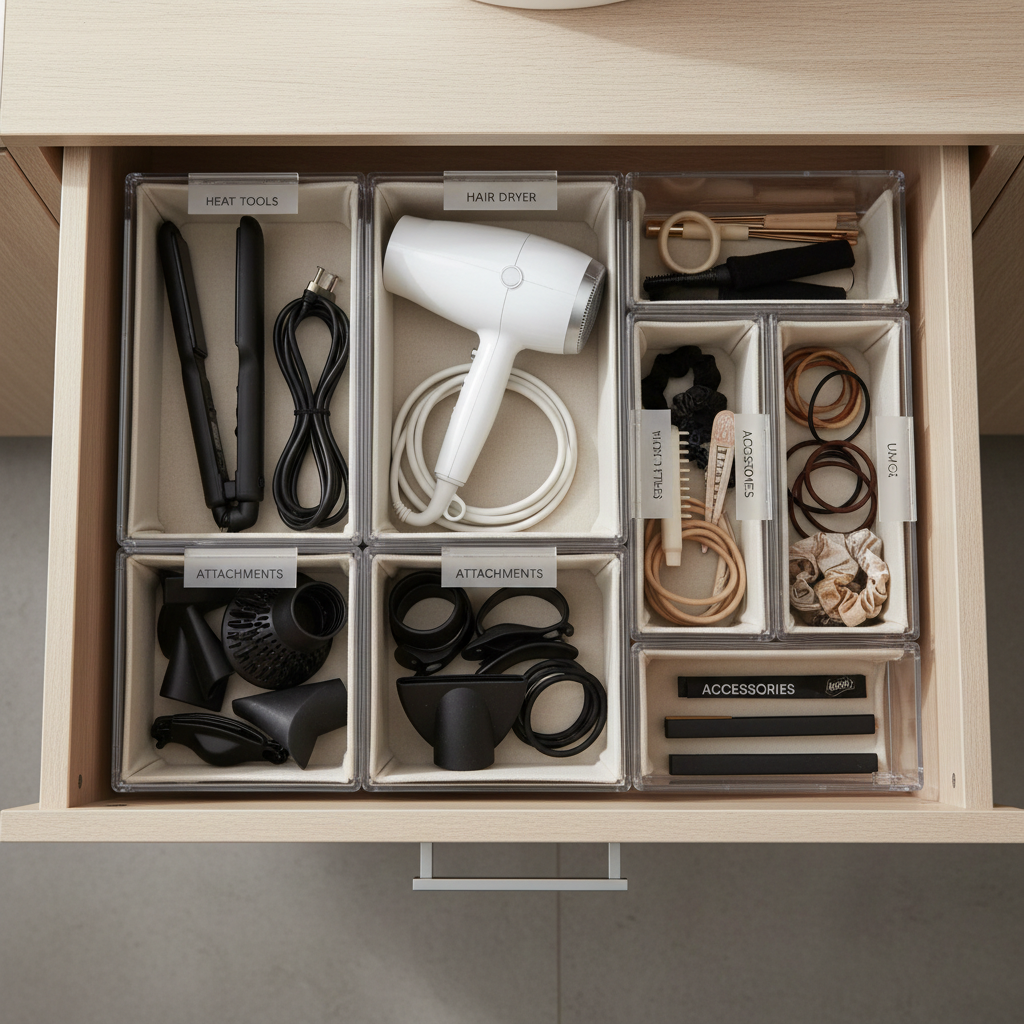
Build a drawer layout that stays put (zones beat “one big tray”)
The most reliable approach is a simple zoning layout. Think of it like a kitchen drawer: tools in one lane, small items in another, and nothing free-floating.
Recommended zones
- Lane A: Long tools (flat iron, curling iron, hot brush)
- Lane B: Hair dryer + nozzle (or dryer only if it’s bulky)
- Zone C: Heat-safe parking spot (a mat/sleeve area for cooling)
- Zone D: Small accessories (clips, elastics, pins) in a lidded mini bin
- Zone E: Attachments (diffuser, extra barrels) in one container, not scattered
When people ask how to organize hair tools in bathroom drawer without losing space, this is usually the missing piece: you’re not just “sorting,” you’re designing a repeatable path for your hands.
Tools and inserts that work (plus a quick comparison table)
You don’t need every organizer under the sun, but a few right-sized pieces help a lot.
| Organizer | Best for | Watch-outs |
|---|---|---|
| Adjustable drawer dividers | Creating long “lanes” for irons and dryers | Measure drawer height so dividers don’t block closing |
| Heat-resistant mat or silicone sleeve | Cooling hot tools before storing | Not a license to store a tool that’s still very hot |
| Lidded mini bin | Clips, elastics, bobby pins | Too many tiny bins becomes its own clutter |
| Cable ties or hook-and-loop straps | Keeping cords compact and snag-free | Avoid tight bends at the plug end to reduce wear |
| Shallow tray insert | Brushes, combs, small products | Pick one with grippy base so it won’t slide |
Key point: For most bathrooms, dividers plus one small bin and one heat-safe spot is enough. The moment you add five container types, maintenance gets harder.
Step-by-step: set up the drawer in 30–45 minutes
This is the part that makes the system feel “done,” not half-done.
- Measure the interior: width, depth, and usable height (account for drawer lip).
- Place long lanes first: allocate the longest lane to your most-used hot tool, not to a random brush.
- Create a cord rule: every tool gets a strap, cord wraps once loosely, plug sits at the back.
- Make attachments a single unit: one bin or pouch, otherwise they migrate.
- Add a cooling routine: tool goes on the heat mat on the counter (or a safe spot) until it’s warm, not hot, then into the drawer.
If you live with others, label one bin “hair accessories” so nobody dumps floss picks or sample packets into it. It sounds small, but it stops drawer drift.
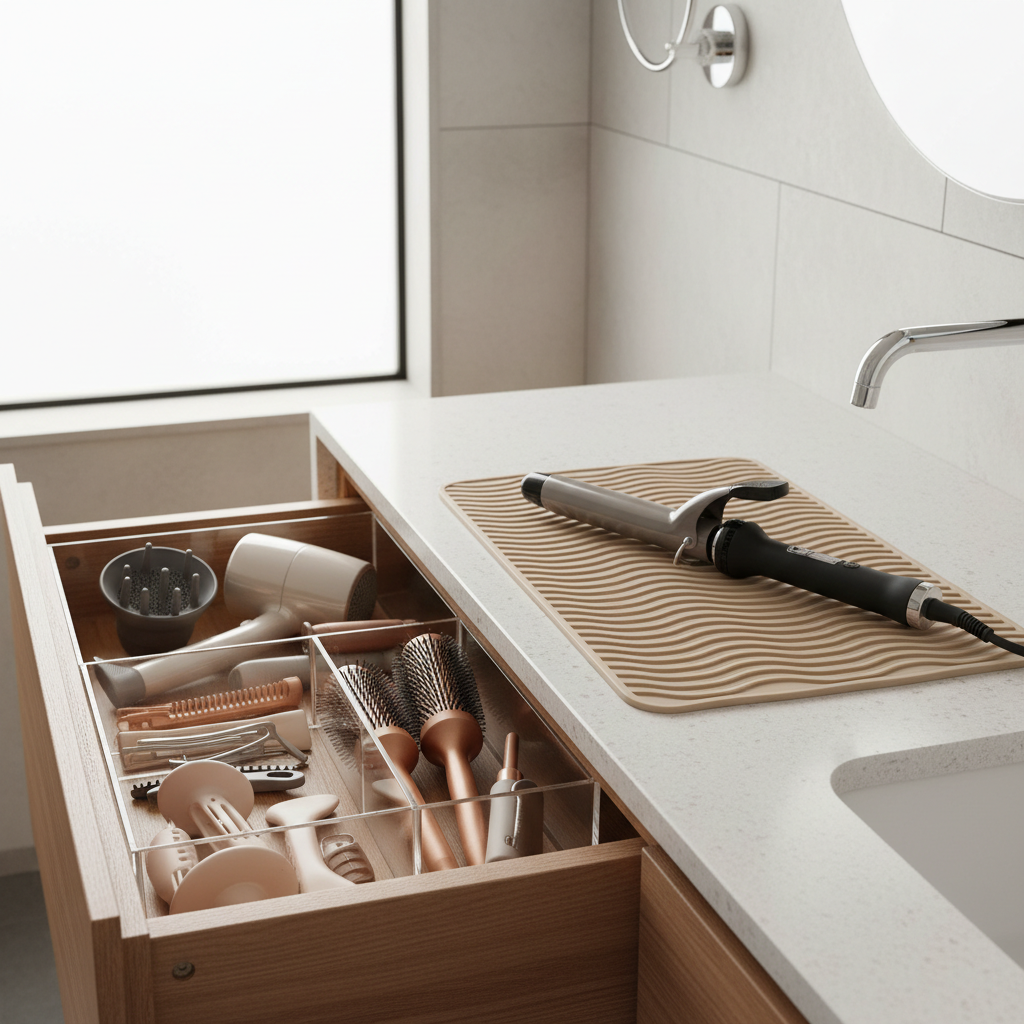
Safety and “don’t waste your time” mistakes
Bathrooms are humid, and hair tools involve heat and electricity. You don’t need to be anxious about it, but you do want a few non-negotiables.
- Don’t store tools while hot: even with a silicone sleeve, heat can build up in enclosed spaces.
- Avoid packing tools against aerosols: hairspray and dry shampoo are often flammable, store them elsewhere when possible.
- Skip plush drawer liners near hot tools: they can trap heat and hold odor, a wipeable liner is easier.
- Don’t over-tighten cord wraps: tight bends can stress the cord at the strain relief, especially on older tools.
- Keep water risk in mind: store tools away from sink leaks and puddle-prone areas, and unplug when not in use.
According to the National Fire Protection Association (NFPA), safe use of heating and electrical appliances includes keeping them away from combustibles and following manufacturer instructions. If your tool manual has storage guidance, follow that over any generic tip.
Conclusion: the simple system that holds up week after week
Once you commit to zones, cord control, and a realistic cooling routine, how to organize hair tools in bathroom drawer stops being a weekend project and becomes a set-it-and-forget-it setup. Aim for fewer categories, not more containers, and make “put-away” as easy as “take-out.”
Two actions that pay off fast: measure your drawer today, then set up two long lanes and a small accessories bin. If you do only that, the drawer already feels calmer tomorrow morning.
FAQ
How do I organize hair tools in a shallow bathroom drawer?
Use fewer items and keep the layout flat: one long lane for your daily hot tool, one space for a compact dryer (or store the dryer elsewhere), and a small lidded bin for accessories. Shallow drawers punish overstuffing.
Can I put a curling iron in a drawer with a heat-resistant mat?
A mat helps during cooldown, but many situations still call for waiting until the tool is no longer hot to the touch. If you’re unsure, check the manufacturer guidance, and err on the cautious side.
What’s the best way to keep cords from tangling?
Give each tool a simple strap and wrap loosely, then park the plug at the back of the lane. When cords all point the same direction, the drawer stops “catching” when you open it.
Where should I store attachments like diffusers and extra barrels?
Keep them together in one bin or pouch so they act like a single item. If attachments live loose in the drawer, they end up blocking the tool lanes.
Should hair brushes go in the same drawer as hot tools?
Often yes, if you use them together, but separate them with a tray so bristles don’t snag cords and clips. If the drawer feels crowded, brushes can move to a countertop holder.
How do I share a bathroom drawer without it turning into chaos?
Divide by person or by function, but pick one. A labeled bin per person works well, and it reduces the “I’ll just toss this in” habit that ruins the system.
What if my hair dryer is too big for any drawer?
That’s common with higher-wattage dryers. Store it in a nearby cabinet, under-sink bin, or a wall-mounted holder, then keep only your hot tool and accessories in the drawer.
If you’re trying to organize a cramped vanity and want a more “grab-and-go” setup, it may help to choose a matched set of adjustable dividers, a heat-resistant mat, and one lidded bin sized to your drawer, so the system feels cohesive without adding extra clutter.